
Writing a good prompt · for your AI
Writing a good prompt
---
id: a-good-ask
title: Writing a good prompt
topic: usage
level: 1
builds-on: [what-ai-is]
modes: [day-pack, rucksack]
moment: "they send a one-line ask and get a generic answer, or they ask why the AI did not understand what they wanted"
keywords: [prompt, prompting, how to ask, generic answer, task, background, context, shape of the answer, format, length, tone, write a better prompt]
related: [what-ai-is, how-a-chat-starts, custom-instructions]
checked: 2026-10-20
---
What it is
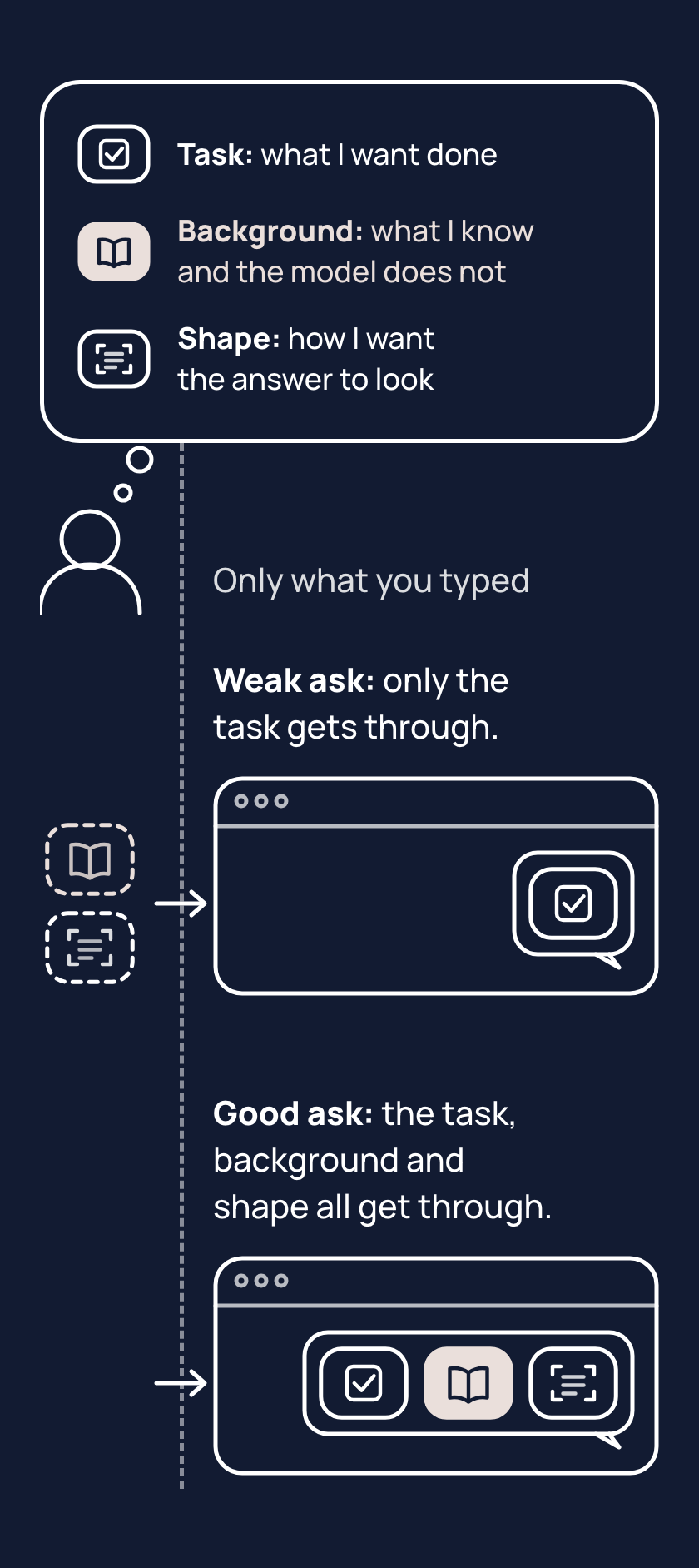
An ask is what you type to your AI app to get something done. The model behind the app knows little about your task beyond what you typed, so a one-line ask leaves the model guessing.
A good ask has three parts. The task is what you want done, starting with a verb. The background is what the model cannot see, such as who the answer is for. The shape of the answer is its length, its form (a list or email) and its tone.
"Write a bio for me" gives only a task. This gives all three: "Write a three-sentence bio for my real estate website. I've sold houses in Geelong for twelve years and I'm known for first-home buyers. Keep it warm, not salesy." Some asks need only the task. Extra words help when they tell the model something it cannot see.
Tips
- Start your ask with a verb for what you want done, because the task tells the model what to make.
- Add one or two lines of background, because the model knows little about your task beyond what you typed and often fills a gap with a guess.
- Say the shape of the answer, such as its length or form, because an answer in the shape you need is one you can use straight away.
Try it
- Pick one real task you want done this week.
- Open a new chat and send your usual one-line ask for the task.
- Open a second new chat and send the same ask with a line of background, such as "It's for my real estate website, and I'm known for first-home buyers."
- In that second chat, also say the shape of the answer you want, such as "Three sentences, warm, not salesy."
- Read both replies and pick the one you could use as it stands.
The reply to the fuller ask often fits your need more closely. If the two replies are alike, your first ask was already enough, perhaps because the task was simple. Two replies to the same ask can differ, so do the steps again if the two replies are close.
Risks
- Background travels with your ask to the company that runs your AI app. Replace names, account numbers and other private details with plain labels, such as "a client".
- Too much extra information can make the answer less helpful. A paragraph of history or a long list of rules the task does not need can pull the answer off course. Keep the task, the background and the shape of the answer, each as short as you can, and cut anything the task does not need.
- A reply that fits your ask can still be wrong, because the model can write a wrong answer in the same tone as a right one. Check any fact before you rely on it.
- If you leave out the shape of the answer, the model chooses one, and you may get an essay when you wanted three lines. Say the length and form you want.
Why it matters
A good ask tells the model what you need. The model can only use what you give it, so when an answer comes back generic, check which part you left out.
Related concepts
Outcomes
- a-good-ask-1 (Asking, waypoint 1): I can write an ask with the task, the background and the shape of the answer. Proves: one real ask of theirs, rewritten with the three, gets a better result than their usual one-liner, and they say which part made the difference.
- a-good-ask-2 (Asking, waypoint 1): I can tell which part a weak ask is missing. Proves: given a one-line ask (theirs or a sample), they name the missing part and what the model would have to guess.
What success looks like
Their first asks carry a verb, a line of background and the shape they want; fewer follow-ups saying "no, shorter" or "it's for my boss".
Fast track
- Explains: a good ask has three parts: the task, starting with a verb; the background the model cannot see; and the shape of the answer (length, form, tone). A one-line ask leaves the model guessing.
- Ask: "Here's an ask: 'Write a bio for me.' What's missing, and what would the model have to guess?" Shows it: the background (who it is for, what they do) and the shape (length, tone); the model guesses both.
- Ask: "Rewrite it with all three parts." Shows it: a task with a verb, a line or two of background, and the shape they want.
Ways to teach it
Hints for the person's AI. Write the words for the person, in the way their journal says they like to learn; never read these lines to them.
- Experiment: the person picks one real task and tries two asks in two new chats. The first is their usual one-line ask. The second is the same ask with the task, the background and the shape. They say which reply they could use as it stands and count the follow-ups each would need. If the first was already enough, perhaps the task was simple. In a Daypack, setup step 6 (the first thing to try) is this experiment on a real task from what they use AI for.
- Challenge: for a week, the person adds a verb, a line of background and the shape they want to every first ask. They notice how often they still send follow-ups such as "no, shorter" or "it's for my boss".
- Quiz (only if their journal allows quizzes): two parts. First, "Write a bio for me" and two other one-line asks: the person names the missing part and what the model would have to guess. Second, three sample sentences to sort into task, background and shape.
- Cards: four, one each for the task, the background, the shape of the answer, and "the model knows little about your task beyond what you typed".
- Explain: rewrite the person's last one-line ask with them. Ask them for the background and the shape instead of supplying both, then compare the two versions.
- Game, "what would a new colleague ask back?": give the person a one-line ask. They say what a colleague who knows nothing of their job would ask in reply. Each question is a missing part.
Watch out
- Three parts, never more: persona, examples and limits belong to other pages (examples-and-constraints, refine-and-ask-back). Never "prompt engineering", "magic words", "act as an expert" (expert personas do not reliably improve accuracy).
- No vendor says the ask matters less with newer models, only that tricks do; never tell the person a newer model "just knows" what they want. Models guess unstated requirements, and often wrongly (ACL Findings, July 2026).
- Longer is not better: stacked rules and unneeded detail can make the answer worse. The overcorrection is a huge templated ask; the answer is the three parts, short.
- Tone and politeness are not the lever; say so only if asked.
- No controlled study shows the three parts improve ordinary tasks; the evidence is vendor guidance and small studies. Say "often", "more likely", never a promised result.
- Background increasingly comes from files, memory, connectors and the person's own instructions; the instructions carry standing background (custom-instructions).
- Daypack: setup step 6 is this concept's proof, on a real task from "I use AI for". (checked 20 October 2026)
Questions people ask
- Q: Why is the answer so generic? A: The model knows little about your task beyond what you typed, so a one-line ask leaves it guessing. Check which part you left out: the task, the background it cannot see, or the shape of the answer.
- Q: Why did I get an essay when I wanted three lines? A: If you leave out the shape of the answer, the model chooses one. Say the length and form you want, such as "three sentences" or "a short list", and the tone if it matters.
- Q: Do I need to include all three parts every time? A: No. A simple ask may need only the task. Add background and shape when they tell the model something it cannot see, such as who the answer is for or how long it should be.
- Q: How long should an ask be? A: Long enough to close the gaps the model cannot fill, and no longer. A line or two of background and the shape you want is often enough. Detail the task does not need can pull the answer off course.
For your AI
Facts (checked 20 October 2026; research note research/2026-10-20-concepts/a-good-ask.md).
What the vendors teach ordinary people. OpenAI Academy: outline the task, give helpful context, describe your ideal output; "too much extra information can sometimes make the answer less helpful" (https://academy.openai.com/public/clubs/work-users-ynjqu/resources/prompting, updated 4 September 2026). Anthropic: state the format and level of detail, say why; "Start simple and add complexity only when needed" (https://claude.com/blog/best-practices-for-prompt-engineering, 10 November 2025); treat Claude as "a brilliant but new employee who lacks context" (https://platform.claude.com/docs/en/build-with-claude/prompt-engineering/claude-prompting-best-practices). Google: persona, task, context, format, "you don't need to use all four"; the verb is "the most important component"; fruitful prompts average about 21 words, typed ones under nine (vendor observation) (https://services.google.com/fh/files/misc/gemini_for_workspace_prompt_guide_october_2024_digital_final.pdf). Microsoft: goal, context, expectations, source; "all that's required is a clear goal" (https://support.microsoft.com/en-us/microsoft-365-copilot/get-started-writing-prompts-in-microsoft-365-copilot). The three parts here hold all four: goal and task are the task; context and source are the background; expectations and format are the shape.
Evidence. Models infer unstated requirements 41.1 per cent of the time, and underspecified prompts were twice as likely to get worse when the model changed (https://aclanthology.org/2026.findings-acl.441/, July 2026). Prompts that lacked certain parts, such as request-only "best of" asks, often led to long back-and-forth conversations (Nielsen Norman Group diary study, 18 people, 24 November 2023: https://www.nngroup.com/articles/ai-prompt-structure/). Accuracy fell as the number of stacked instructions rose (https://arxiv.org/pdf/2509.21051). Expert personas did not reliably improve accuracy (Wharton, 7 December 2025: https://gail.wharton.upenn.edu/research-and-insights/playing-pretend-expert-personas/). Politeness had no reliable aggregate effect (https://arxiv.org/abs/2503.04818).
Questions people ask. "Do I need all three?" No; a simple ask may need only the task. "How long?" Long enough to close the gaps the model cannot fill. "Do I need 'act as an expert'?" Not for accuracy. "Should I say please?" No reliable effect. "Why is the answer generic?" The model filled the gaps with guesses. "Can the AI write my ask for me?" It can help; see refine-and-ask-back. "Do I need to learn prompt engineering?" Not to start.
An example of this taught well, in passing, after "Write a bio for me" came back generic: "That's a fair first go; it had to guess everything. Two lines would change it: what it's for and how long. For instance: 'Three sentences for my real estate website; I'm known for first-home buyers; warm, not salesy.' Want to try that and compare?"